Prisoner of War
Personal Recollections of Dean O. Holman
Writing of this account begun November 22, 1988
Typed on word processor by Cary Holman April
1995
Edited July 1997
Read more about Dean
Holman's earlier experience as a prisoner-of-war.
(The spellings of names and places in this account
may not be correct, despite our best efforts.)
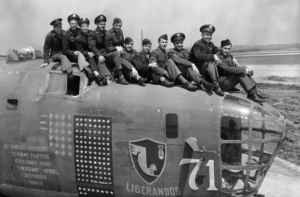
I was part of the 376th Bomb Group stationed near Brindisi, Italy
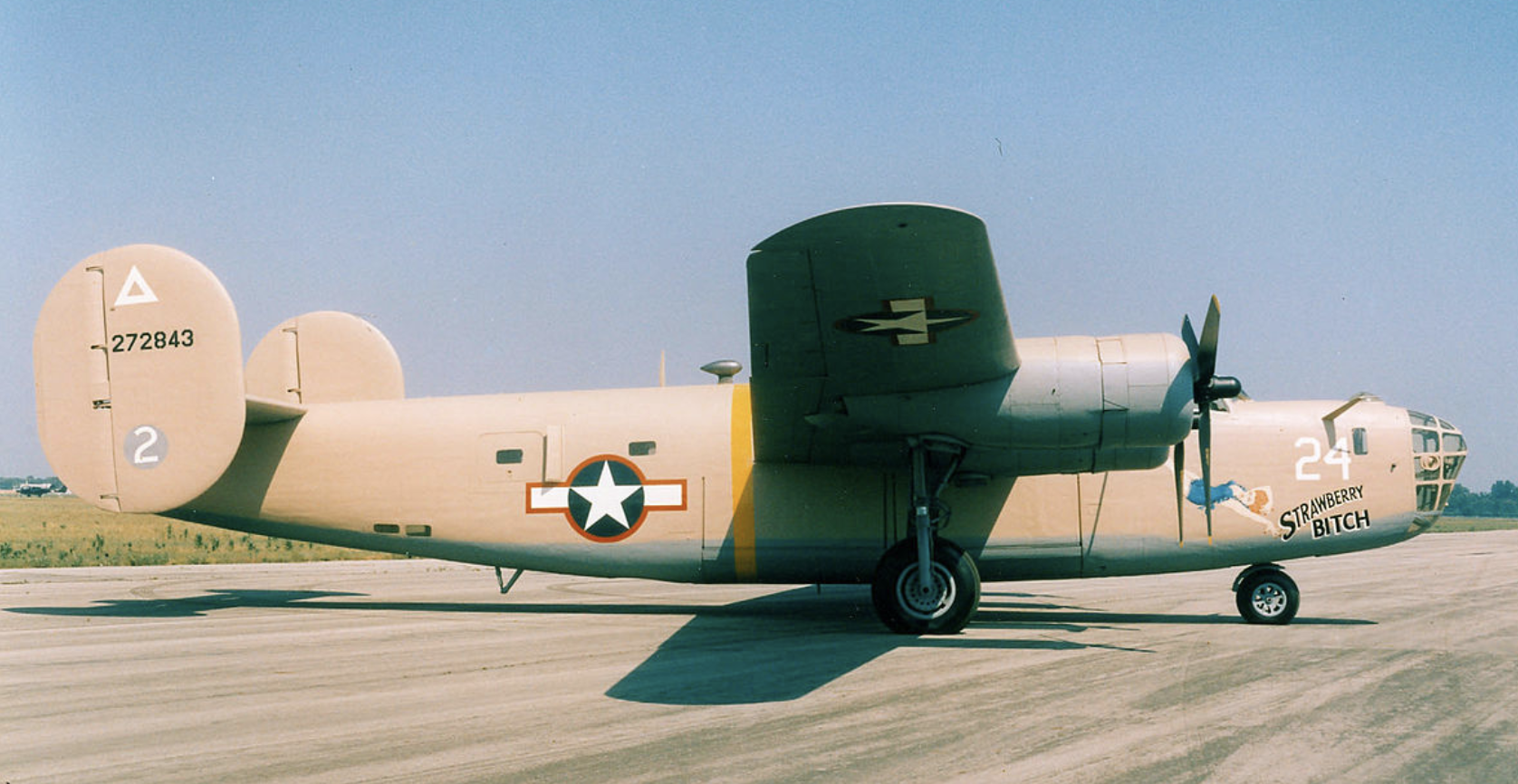
. The morning of February 23, 1944 , our B-24 Liberator Bomber
crew was not supposed to fly. The day before our pilot, Lieutenant
Eugene Thurman, had gotten his feet frostbitten when the heater
in the cockpit failed. But at 4:00 AM they woke me to say I
was going with another crew that was also part of our 376th
Bomb Group. One of their crew had too much to drink the night
before and was sick. It was the first time I had flown with
another crew. I had only met the tail gunner. This was my thirteenth
mission.
Some of the enlisted men said that I would be flying in the
nose turret. The man in the nose turret was shut in by the
navigator. I understand there was no handle to the door on
the inside of the turret. Space was very tight. The nose turret
gunner's parachute was on the outside of the turret. So he
had to rely on the navigator or bombardier to open the door
so he could get out in case of an emergency. I refused to fly
in that position because I had never flown in combat with the
navigator nor bombardier on this crew. So this day I flew as
one of the two waist gunners.
Our target for our bombing group that morning was a ball bearing
factory in Steyr , Austria . Usually we were to be over our
target close to noon so that any anti-aircraft had to shoot
into the sun. The 8th Air Force from England was to hit targets
in another area in Germany that would spread out the German
fighters. But the 8th Air Force could not take off because
of bad weather. Also, a group of B-17s at Naples , Italy ,
was grounded. So our two groups of B-24s was all the Germans
had to shoot at.
We encountered Messerschmitt 109 fighter planes, known as
Goring Yellow Noses because they painted the nose cone yellow.
They were the top pilots of the German Air Force at that time.
I don't think there was any ground fire. I saw no smoke that
follows when anti-aircraft shells explode. And, it would be
unlikely that they would shoot into the air when their own
fighters were also flying there.
Before our plane was hit there was so many men bailing out
of other damaged planes that we could not report them all.
When our plane was hit I knew I was hit in the left leg. When
I got up I could not stand on it. When I got back up I fired
at one of the German planes while standing on one leg. It was
probably out of range. This was the only time I ever fired
at an enemy plane.
The Messerschmitts carried a 9 mm cannon and a 50 calibre
machine gun. My ankle wound could have been from a 50 calibre
machine gun. But it was probably from a cannon shell exploding
because I also had shrapnel wounds in my back, stomach, shoulder,
right leg, and buttocks. I even have little tiny pieces of
shrapnel in my right hand that were never removed.
We could see the plane was on fire, and the intercom to the
men in front of the plane was out. We started to get our parachutes
on. We wore a harness but had to attach the chest parachute
to the harness when we were ready to use it. There were four
men stationed in the back of the plane. A hole for the purpose
of bailing out was on the floor of the plane. The first man
ready to jump sat down at the hole with his feet out the hole,
but did not jump. So the next guy who was ready pushed him
out.
I had trouble with my parachute because a first aid kit had
slipped down where the snap was to go. All of the other three
men stationed at the back of the plane had jumped by the time
I was ready. Some one had told me to be on your back when you
pulled the rip cord. So I leaned back and it worked--you could
get on your back. I didn't think it would work. The reason
was to keep your face from getting cut up by the shroud lines.
It didn't feel like I was going down.
A German plane flew close to me and we waved at each other
while I was still in the air. There wasn't much else I could
do. As I fell I had the sensation that I was going up--not
down--until I could see the ground. It didn't take long after
you could once see the ground to land. When I pulled up my
injured leg I probably had my right leg pulled up too. So I
made a good landing because you were supposed to land with
your knees bent. I remember there was snow on the ground.
After I landed in a field near a farm house a small plane
flew over me. We had an escape kit which had some small chocolate
squares each equal to a meal. I was hungry so I ate several
of the squares.
There were four men and a woman down the hill near the farm
house. I was more afraid of what the women might do to me than
the men. There were stories where women had attacked airmen
who had parachuted after or during a bombing. Some women would
take the opportunity to attack those who had been dropping
bombs on their home. Not all the bombs always hit the military
target. Soon the men came up to where I was. They had an old
rifle. We carried a 45 pistol in a shoulder holster which put
the gun over our heart. They didn't know how to release the
holster. It was held by a snap that I was laying on. I reached
over to unfasten it. They all moved back from me. I always
wondered if they had any shells in their gun. They made no
attempt to point it at me.
They carried me down the hill to the house and laid me on
the floor. It was not long until a German soldier came. I was
wearing an electric flight suit. It was hard on the lady's
scissors to cut through the wire in my suit to get to my leg
wound. I was getting cold. The lady gave me a very small amount
of something to drink. I don't know what it was, but as soon
as I swallowed it I was warm from the inside out. There was
an American lieutenant at the house. He was telling the lady
in English about his daughter, and was showing her the daughter's
picture. We weren't supposed to have a picture of our family,
or any thing except our dog tags. Anything could provide the
enemy with information they could find valuable. Later I found
out he was the navigator on the same plane I had been on from
my description of him to Morris Ruttenburg, who was the tail
gunner and regular crew member on that plane.
They put the lieutenant and me in a bobsled and took us down
a hill to the main road to an ambulance. That is the last time
I ever saw that lieutenant. I do not know whether the lieutenant
also got in the ambulance with me or not. I don't remember
much until I woke up the next morning in the room other than
it was dark when we got to the hospital, which was a hospital
for members of the German Air Force in Wels, Austria .
There were three other Americans in the room with me. Their
names were Morris Ruttenburg, Joe Fritche, and Lieutenant Kendall
Mork. In the bed next to me was the tail gunner from the crew
I was flying with when we were shot down, Morris Ruttenburg.
He had a wound similar to mine in his right ankle. On the other
side of Ruttenburg was Fritche who had similar wounds but in
both ankles. I don't remember what was wrong with Lieutenant
Mork, but he could get out of bed, so he must have not had
leg wounds. We were not out of these beds for the next thirteen
weeks when the hospital was bombed.
There was an English-speaking German nurse in the hospital.
She told us that they had taken our dog tags and told the Red
Cross that we were alive and prisoners of war. But apparently
that message did not get through. The doctor who treated me
was Dr. Mooseman, who was an Austrian professor of medicine
from Vienna before entering service as a Major in the German
Army. The English-speaking nurse was always the nurse with
Dr. Mooseman. The only English I ever heard Dr. Mooseman use
was "move toes."
Five days after I got to the hospital my leg began to swell
in the cast. Dr. Mooseman was gone so they did not do much
about it. When the doctor returned he cut a hole in the cast
and started treating the wound with powdered sulfa. He said
it was gangrene and if he could not stop it in 24 hours he
would amputate before infection reached my knee. The sulfa
did not stop the gangrene. On March 1 they took me to surgery.
They were not sure if they would amputate below or above the
knee. I've always wondered if an American doctor would have
taken the chance to save my knee with the infection that close
to my knee. They took my leg off six inches below my knee,
left it open (they called it a guillotine amputation), and
put four drains in it. I've always been thankful that Dr. Mooseman
saved my knee. About a month later the doctors told me they
thought it would be all right.
When I woke up from the amputation surgery an Austrian girl
was sitting by my bed. She was not dressed as a nurse. The
other fellows said that she had been there ever since I returned
from surgery. She told us that her brother was a prisoner of
war of the United States . We assured her that he was being
well treated. She left shortly after I came to. I never saw
her again.
They fed me white rolls with jam. I ate it for several days
or a week. One day I asked for more. I never got white rolls
and jam again. I was back to the black bread and lard like
all the other prisoners. We offered the lard to a nurse. She
refused out of fear that she would be reported if she was discovered
to have accepted it.
They elevated my leg on a ramp about eight inches high. The
ramp was a smaller version like the ones we use to drive a
car up on. My leg was elevated on the ramp for the next three
months.
My wound was dressed about every other day for a long time.
Within two weeks after the surgery while they were dressing
the wound one of the drains came out my leg. The doctor came
to replace it. He thought it would be a simple procedure. One
nurse held my leg. Another (large) nurse laid across my chest
to keep me from moving by holding the opposite side of the
bed. The doctor then replaced the drain. The pain was terrible.
I screamed and hollered but the nurse was successful in holding
me still. That was the only time that I was hurt. Later the
doctor apologized. He said that if he had known it would be
that painful he would have taken me back into surgery to do
it.
One time when two nurses were changing my bed they were talking
and laughing in Austrian. I laughed with them. One of the nurses
slapped me up the side of my head. She really jarred me. I
never knew what they had been laughing about--and neither did
any of the other prisoners--but apparently I wasn't supposed
to laugh. Then they just went on changing the bed.
After about two or two and a half months I thought I could
get out of bed. When I dropped my wounded leg over the side
of the bed I almost passed out from the pain and fell back
onto the bed. None of us prisoners told the hospital personnel
about the incident. I never tried it again.
It probably would have been longer but at about noon on Decoration
Day 1944 the Americans bombed the hospital. We later heard
that the Allied Air Force knew of our being in this hospital,
but considered us expendable. This holiday in late May was
called Decoration Day because on this day people decorated
graves of loved ones, including but not limited to those of
veterans. Now this holiday is called Memorial Day by most people,
but I still call it Decoration Day.
This hospital was a tar paper barracks type of building. The
bombs that were dropped were fragmentation and incinderary
type. The hospital caught on fire as a result of the bombing
and was destroyed. The bombing run was five waves with two
or three minutes between each wave. After one wave only the
bottom of a water bottle remained on a stand by my bed a few
inches higher than my head. After another wave passed there
was a row of holes a half-inch in diameter in the wall a few
inches above my mattress. I looked to see if I had been hit.
I was not. They must have come from an angle above. After one
of the waves the Lieutenant said that we had better start praying.
I told him that if he was just now starting he was about two waves
behind.
There were eleven other Americans in the hospital with me
at the time, four of us in each of three rooms. All but one
German patient, who was too badly injured to be moved, were
taken to an air raid shelter. Two Americans were killed in
this bombing attack, and one officer received a very bad leg
injury from the bombing. No one in our room was injured seriously
during the bombing. Fritche, however, did receive a minor wound.
The air raid siren sounded often to warn of approaching enemy
aircraft. But for as long as we had been there none of our
planes had dropped any bombs when they flew over. So many of
the local people never bothered to take shelter during this
air raid. A lot of local people were injured because they were
slow to take shelter.
After the bombing stopped a nurse carried me out of the hospital
piggy-back. This time when my injured leg hung down I did not
feel any pain. She handed me down to a man on the street below
who took me across the street to a larger, permanent hospital.
They put me back in the corner of a room full of Germans--I
guess they were Germans because I couldn't understand what
they were saying. I kept my mouth shut because at first some
thought I was part of the bombing raid.
The next day they took the 10 remaining Americans to the second
floor of a school house in a small village nearby. We were
brought food from somewhere in the village. One day the girl
who brought us our food brought cans of peaches for two of
the more seriously injured prisoners. None of us ever got peaches.
They were a real treat. A guard walked in while she was giving
the prisoners this special treat. The guard asked the girl
to leave. She never brought food to us again but we did see
her later in the street from the window.
We could look out the window and see the kids coming to school
to the floor below. As the kids walked by a particular man
on the sidewalk each day they gave the "Heil Hitler" salute.
He may have been the principal or a teacher. The room we were
in had a picture on the wall of Hitler. The guards were seldom
in the room with us except to check on us about once a day.
After the guards left we would turn the picture of Hitler so
it faced the wall. When the guards returned they would turn
it back around. The guards never said anything to us.
We were there from four to six weeks. Dr. Mooseman continued
to be our doctor. He had received orders that we were to be
moved. On June 30, 1944, we were sent by train to a prison
hospital at stalag 9C at Obermassfeld , Germany . The train
had wooden seats. I had been either in or on a bed for the
last four months, so the seats seemed very hard. There was
one row of potatoes along the train tracks that seemed to go
on for miles. On the way we passed through a German interrogation
center. The German interrogator spoke perfect English. We had
been in the hospital for the last four months, so we weren't
expecting to be interrogated. During the interrogation they
took all the names and addresses we had of the German army
doctors and two nurses who took care of us. I've often wanted
to write them. I sure wish I had their addresses. The interrogator
left a notebook on my bed when he left the room. When I looked
at it it had listed many Americans in different crews. Not
all the listings of the crews were complete. Later he returned
and took the notebook.
A few weeks later, on July 26, my folks found out I was a
prisoner of war. Up until that time I was just missing in action.
I assume that the news of my status had to do with the interrogation.
They announced at the Farmer City Fair that Dad had received
a telegram. Dad picked it up at the depot and my family then
found out that I was a prisoner of war. It was announced at
the Fair.
At the hospital at Obermassfeld the doctors were Australian
and English doctors, many who had been prisoners for a long
time. They worked under the supervision of German doctors.
The only officers we ever saw were these doctors. They did
not live with us. All of us that lived together were enlisted
men.
We spent all our time in one very large room at the hospital
in Obermassfeld. The one room held 50 or 60 people, maybe more,
from 6 or 7 countries. We were put in groups of 5 or 6 prisoners
to prepare our meal. We called each group a combine. I don't
remember why. Each combine prepared one meal each day in a
small bread pan. The Germans furnished us potatoes and black
bread pretty often. We also could withdraw some items from
our Red Cross parcels to combine with the potatoes. They would
heat the meal we prepared in this one pan once a day. I don't
remember what we ate the rest of the time.
The Red Cross parcels were held by the Germans. They were
intended to last for a month. We could check out items from
our parcels as often as once a day. If we checked out a canned
item the can was punctured so that you couldn't save it for
escape purposes. The parcels often contained salmon, sardines,
cigarettes, candy bars, crackers, and raisins. The cigarettes
and chocolate bars had the highest trading value. At the time
I did not smoke so I traded my cigarettes mostly for candy
which I could eat between meals. When a guard was alone sometimes
he would trade us for seasonal vegetables such as tomatoes
or onions to add variety to our meal. The trades almost always
occurred in the latrine. That's the only time a guard could
be pretty sure no other German would oversee the trade.
There wasn't much to do. We did have heated discussions about
whose country was doing the most for the war effort. Usually
it was the English and the Americans that were the most involved
in these discussions.
One American prisoner, Warren Rudolph, whom we called Rudy,
would tell ghost stories sometimes at night after the lights
were out. He would just make them up as he went along. He could
just go on and on with them. The whole group would sit and
listen to his stories. One night during a thunderstorm he was
telling one of these stories. The man on the top bunk above
Warren had a shoulder cast. He rolled over and dropped his
arm over the side of the bed at the same time as a lightning
flash. It scared Rudy who was telling the story. He let out
a big yell. The group kidded him from then on about being scared
by his own ghost story.
There was a small room at the end of the large room we all
stayed in. We never used that room. One day they carried in
an injured Canadian soldier who did not want to live into this
small room. They asked some of the prisoners to go in to talk
to him. A few tried, including fellow Canadians, but no one
had been able to get him to respond in any way. Then Rudy said
he would go to talk to him, and that if the soldier still wanted
to die when he was through talking to him he ought to die.
Rudy talked to him for over an hour and the man responded.
A few days later they carried him back to his former quarters.
That was the last we ever saw of him. We thought that Rudy
just talked him out of dying.
We found other forms of entertainment. We would gather around
the bed of someone coming out from under anesthetic to see
how they talked and reacted. Sometimes we would have group
singing. The guards couldn't understand why we would be singing
since we were prisoners of war. Late at night after lights
were out once in a while someone would have heard news that
we would gather around to hear. Usually the person with the
news was an Allied doctor with a secret radio.
My knee was stiff because it was on the ramp for over 3 months
after the amputation. One day while walking on crutches the
crutches slipped on a wet floor. When I fell I bent that knee
back all the way. I passed out from the pain. When I came to
my knee would bend normally. It probably saved months of therapy.
The last few weeks at Obermassfeld we were moved from the
large room out to some barracks. Any time an air raid siren
sounded we were ordered back inside the barracks. The American
fighter pilots would fly pretty high over us. Before we went
back inside one of the prisoners who was an English man would
shake his fist and imply that the American fighter pilots were
afraid to come down and strafe the area so he could see them.
One time one of the pilots did fly low and strafe the nearby
railroad yard. When the gunfire began the English man was one
of the first prisoners under a bed. So he missed seeing the
American plane.
In this strafing attack some of the Germans were hurt. They
asked the prisoners to be blood donors for the injured Germans.
I heard that some of the prisoners volunteered. No one that
I knew did, but probably no one in the barracks I was in was
healthy enough to give blood.
We had been eating black bread since we arrived at Obermassfeld.
One day we tried to toast it on the heating stove. The bread
caught on fire around the edges, on the crust of the bread.
We later heard that the bread was rolled in sawdust. Maybe
it was the sawdust that caught on fire. The bread was also
very heavy. The guards would carry it in on one arm as you
would firewood. When they dropped the loaves on the table it
sounded like they had dropped firewood, too. When the guards
moved us by train the guards carried briefcases filled with
this bread and jam for themselves to eat. It is all I ever
saw them eat.
All those prisoners whose names were on the repatriation list
were moved by train to another stalag, 4D, at Annaburg , Germany
. According to records from Joe Fritche, that was on November
1, 1944 . We were there until January 15, 1945 . There we had
better food and better privileges, including access to a library
and occasional walks in the woods outside the stalag. We had
a good Christmas dinner there. On some of the walks we picked
up small limbs to use for a Christmas tree and tin foil thrown
out by Allied planes to interfere with German radar. We used
that to decorate our rooms for Christmas.
On January 15, 1945, we were put on a train to go to Switzerland
for an exchange of prisoners. There were cars on the same train
for general German passenger transportation. They carried me
through the train station at Frankfurt to change trains. That's
where I saw the most damage from Allied bombings.
One time while in a train station the air raid siren sounded.
The train pulled out very quick. Just outside of town the train
stopped with a large hill on one side of the train and a wooded
area on the other. Everyone but the prisoners left the train--guards
and all--and went into the woods. When the American planes
were gone they all got back on the train and we continued on
our way. When we stopped in Switzerland a train loaded with
German prisoners of war were on the track a few feet from us
headed back to Germany .
We arrived in Switzerland January 20 at 1:00 AM . Throughout
our trip all lights had been blacked out. As we approached
Switzerland that night it was very noticeable that in Switzerland
all the lights were on. The next morning we were allowed off
the train for about an hour. But none of us had any money to
spend. While here we were each given a bag from the Red Cross
containing toilet articles. That bag hung for years at our
home on the farm on the back of the bathroom door as a rag
bag until it wore out.
From there we went to Marseilles, France . We arrived on January
22. We were put on an American hospital ship, the U.S. Algonquin.
That was the first time since I had left Italy on February
23, 1944 , that I had seen the American flag flying. I was
put to bed and started other medical treatment. The treatment
may have included penicillin, but maybe not. At that time penicillin
was a relatively new drug, and may not have been that available.
They wouldn't let me out of bed.
According so some records we were put on the American chartered
Swedish exchange ship, the Gripsholm, on January 24. But we
were in port for a couple of weeks. There were 2 or 3 men to
a cabin. We had good food since the Gripsholm was a luxury
liner. On the way home on the Gripsholm I received 50 penicillin
shots, one every four hours, by a male nurse. He was very good
at giving shots. After a few days he didn't even wake me when
he gave me the shots while I was sleeping.
On the Gripsholm all prisoners were given $75.00 of their
back pay. I had been paid last at the end of January, 1944.
I had twelve months of back pay coming. That was the only year
I have ever saved 100% of my salary.
They said that they would open the bar on the Gripsholm when
we got to sea. If there was any trouble and they had to close
the bar it would not be opened the rest of the trip. Apparently
there were no problems because it remained open.
My roommate on the Gripsholm, Lloyd Helms, did not come back
to the cabin one particular night. About midnight I started
looking for him. I found him on the top deck asleep in a deck
chair, having had too much to drink. Other people had thrown
their blankets over him to keep him warm. He had a leg off,
too, and so was on crutches like me. I got him up and back
to the room with some difficulty. He still was not sober. I
told him the next morning that that was the last time I would
come and get him. The next time he could just sleep outside
in a chair all night. It never happened again.
We arrived in Staten Island, New York, on February 21, 1945
. All the way across the ocean I was up on crutches. But they
wouldn't let us walk off the Gripsholm. I was taken off board
the ship on a stretcher. I think the stretchers were just for
publicity. We were taken to Halloran General Hospital , in
Staten Island . As soon as we arrived at the hospital we were
once again allowed to be up on crutches.
There must have been hundreds of wounded prisoners on the
Gripsholm. All were processed at this hospital. We could all
make one call home as soon as phone lines were available. My
folks did not have a phone. I probably called Parrs, Coxes
or Nicklauses. Wherever I called it seems that my folks were
there and I was able to speak with them. I don't know how I
knew where to call or whether their being there was just by
accident.
A group of people from the USO came to the hospital and gave
a party for all of us on the first Friday night after we got
there. Some of the girls invited the three of us at our table
to come to a party the next night at a private home in Brooklyn
. The other two fellows could not go on Saturday night. One
had relatives coming to meet him. I went alone. They told me
how to get there by train from the hospital. There were several
other servicemen at the party, but I was the only one who had
been a prisoner of war. They seemed to think I had been starved
and I needed to eat a lot more. The rich food was nearly making
me sick because my system was not used to the amount and richness
of such food over the past year.
When the party was over there were no more trains running
back to the hospital. One of the girls who had invited us,
Carol Lukes, took me home with her. She woke up her folks to
tell them I was there. The next morning her mother served bacon--which
was rationed at that time and very hard to get--and eggs, and
offered to try to get me anything I wanted for breakfast. After
I was discharged and raising hogs I sent Mr. and Mrs. Lukes
an entire side of cured bacon. I stayed at their home most
of the day on Sunday. I went back to the hospital that evening,
which was 24 hours late on my pass. No one had missed me but
those in my room.
From this hospital soldiers were sent to the closest hospital
to their home that could treat their wounds. For me that was
Percy Jones Hospital in Battle Creek, Michigan. A few days
later I was sent to Percy Jones Hospital. The first weekend
I was there neighbors from home, Marcus and Pearl Parr, brought
Mom and Dad to see me. During that visit Mom told me that they
had received news that five of my original crew had been killed.
They had flown a group of officers from Italy to England while
I was a prisoner of war. When leaving England their plane crashed
on takeoff and exploded. Those killed included the pilot, First
Lieutenant Eugene Thurman from Texas; co-pilot, Second Lieutenant
George H. Jensen; the naviagator, Second Lieutenant Walter
E. McKay; first engineer, Staff Sergeant Milton Hewitt of Kansas;
and radio operator, Staff Sergeant Joseph C. Rosendale of Massachusetts.
Later I could get weekend passes (Friday night to Sunday night)
to go home. I would take the train to Chicago and change to
another to Clinton. The train went through Farmer City but
did not stop there. I usually changed trains at 63rd Street
station on the south side of Chicago. If I had time between
trains I would call Richard Cox and he or someone else would
meet me in Clinton. Sometimes I had to wait and call from Clinton.
One time a railroad employee got off at Kankakee and called
Richard so I wouldn't have to wait in Clinton. Because I was
using crutches I always had a seat, although the train was
usually full.
After coming home several weekends the doctor said I had to
stay in bed and keep my leg elevated for two weeks before they
would do surgery because my leg had not healed. The wound was
all scar tissue except for an open spot right in the center
about the size of a half dollar. The doctor needed to cut some
more bone off so he could remove the scar tissue and get the
skin pulled together to sew it up. He wanted to leave at least
six inches of stump to permit use of an artificial leg. I think
that is when I started smoking. I don't know why.
All the men in our room (10 or 12) had either one leg or one
arm off and needed surgery. When someone was going to surgery
our room had a routine. When they came to get them everyone
would be real quiet and one man would play taps on the harmonica.
He could really play taps. It would send chills down our backs.
When they went through the door all of us would wish them well.
Some of the hospital personnel thought it was cruel, but all
of us had or would have the same treatment.
Often I would get in a wheelchair (an older wooden kind) with
a tray and Tom Carter, who had an arm off, would push me to
the commissary to buy milk shakes for who ever wanted them
in our room. He couldn't carry a tray, and I couldn't walk.
But together we could get the milk shakes. We usually brought
one for the nurse in the doctor's office. One day after the
doctor had told me to stay in bed we went after the shakes
and took one to the doctor's office for the nurse. Instead
of the nurse at the desk it was the doctor. Tom pushed me up
to the desk. I didn't know what to say, so I just gave the
doctor the milk shake and we got out of there. I was afraid
he would recognize me and wonder why I wasn't in bed with my
leg elevated. If he found out I had not been in bed for two
weeks he might have postponed my surgery. This was the only
time I ever saw the doctor in his office.
On Sunday before my surgery it was nice and warm so Tom took
me out in the yard for a ride in a wheelchair. We didn't think
the doctor would be at the hospital. We were on the sidewalk
when another patient in a wheelchair started to pass us. So
Tom started to race. The footrest on my wheelchair hit a raised
place on the sidewalk and stopped. I landed several feet out
in the yard. I wasn't hurt, but we decided to go back to the
room before somebody got hurt.
The morning of May 8, 1945, I went to surgery to shape and
finish the amputation started in Austria because my leg had
not healed. Just before I left the room we heard the German
Army had surrendered. I had a spinal shot so I talked to the
doctor during the surgery. He started talking with me about
the send-off our room gave to surgery patients. I told him
we had discussed in the room what filing on a bone sounded
like. We would run a file that we had been given to do craft
work across the rail of our bed. We would tease a fellow about
to go to surgery that when the doctor had to file on bone it
would sound like us running a file across the iron bed rail.
When the doctor started to file on mine he told me that that
was what he was doing. And to my surprise it sounded like filing
on metal. I still don't see how that was possible.
Remember, our room had only single amputees. For a short time
they brought a double leg amputee into our room. One day during
visiting hours several mothers were visiting other patients
in the room. The double leg amputee asked another patient walking
by to pick up something that had fallen off the foot of his
bed out of reach. The guy turned to him and said, "You're not
crippled. Get it yourself." And he did. The fellows would
often help one another out. But this time the fellow was just
teasing. The mothers were very upset by the remark. We became
much more careful of what we said to each other when we had
visitors.
The only therapy I had after my surgery before I got my artificial
leg was to straighten my knee. Later I was moved out to a barracks
at Fort Custer, Michigan. When my leg was healed I was fitted
with a wooden artificial leg. I think it was in July. August
12 I was best man for Richard Cox and Joan (pronounced jo ANN)
Parr's wedding. My Aunt Angeline Reynolds washed my summer
uniform and put so much starch in it that it was white, and
I couldn't wear it. At that time military personnel still on
active duty were not allowed to wear civilian clothes until
discharged. So I wore my winter uniform in August 1945 in Parr's
farm house. When they threw rice on the wedding party I was
so hot and sweaty that it stuck to me. Richard and Joan had
waited to get married until I could walk on my artificial leg
to stand up as best man.
On September 1, 1945, Richard and Joan Cox and I were walking
past the bowling alley in Farmer City. Millie Stagen was home
for the weekend from Chicago to help her mother celebrate her
birthday. I saw Millie in there bowling. I went in and asked
her if she would go to a movie with us. She did. After my discharge
I made many trips to Chicago to see her.
Later, after I got home, I found out that the pilot and copilot
were the only two killed when the plane I parachuted out of
was shot down. I was discharged October 12, 1945, from Fort
Custer, Michigan.
This has been an interesting experience and I don't regret
any of it. I don't remember much about the pain except when
the Germans were carrying me into the farm house and when the
doctor replaced the drain. I started farming with Dad, Warren
B. Holman, and Grandpa (Homer) Holman. Later I bought Grandpa's
part of the machinery and livestock.
Mildred Stagen and I were married September 5, 1948. It was
the best thing that ever happened to me.
The May 1997 edit was to add the information about Dean's
five crew members who were killed while Dean was a prisoner
of war (page 19). The July 1997 edit corrected the header
to read WWII instead of WWI.
CLH
|