Training and Combat Experience of Dean
O. Holman 36-432-660
Written May 30, 1996
Edited July 23, 1996
I left Monticello, Illinois, November 4, 1942, and went to
Scott Field, Belleville, Illinois . I was sent to Keesler Field,
Biloxi, Mississippi, for indoctrination exams and basic training.
The exams showed I should either go into mechanics or machinists
training. But I didn't get much basic training. I was only
there two or three weeks. They cut my basic training short
because they needed to fill a new class of mechanics. So I
was shipped out to Lincoln, Nebraska , where I started Airplane
Mechanics (A.M.) School. Near the end of the classes they asked
for volunteers for gunnery school. I think that was the only
time I volunteered while I was in service. I was accepted but
I had to have my tonsils removed. I went to the hospital at
the end of one class, since we could miss three days and still
stay with the group we were with. I was in the hospital three
days before anyone did anything, and another week after the surgery.
We were sent to Ft. Myers , Florida , in April, 1943, to start
gunnery school. When we finished gunnery school we went to
Salt Lake City, Utah , where I was assigned to a flight crew
in Pocatello, Idaho. When I got there I was assigned to a crew
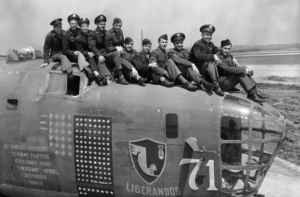
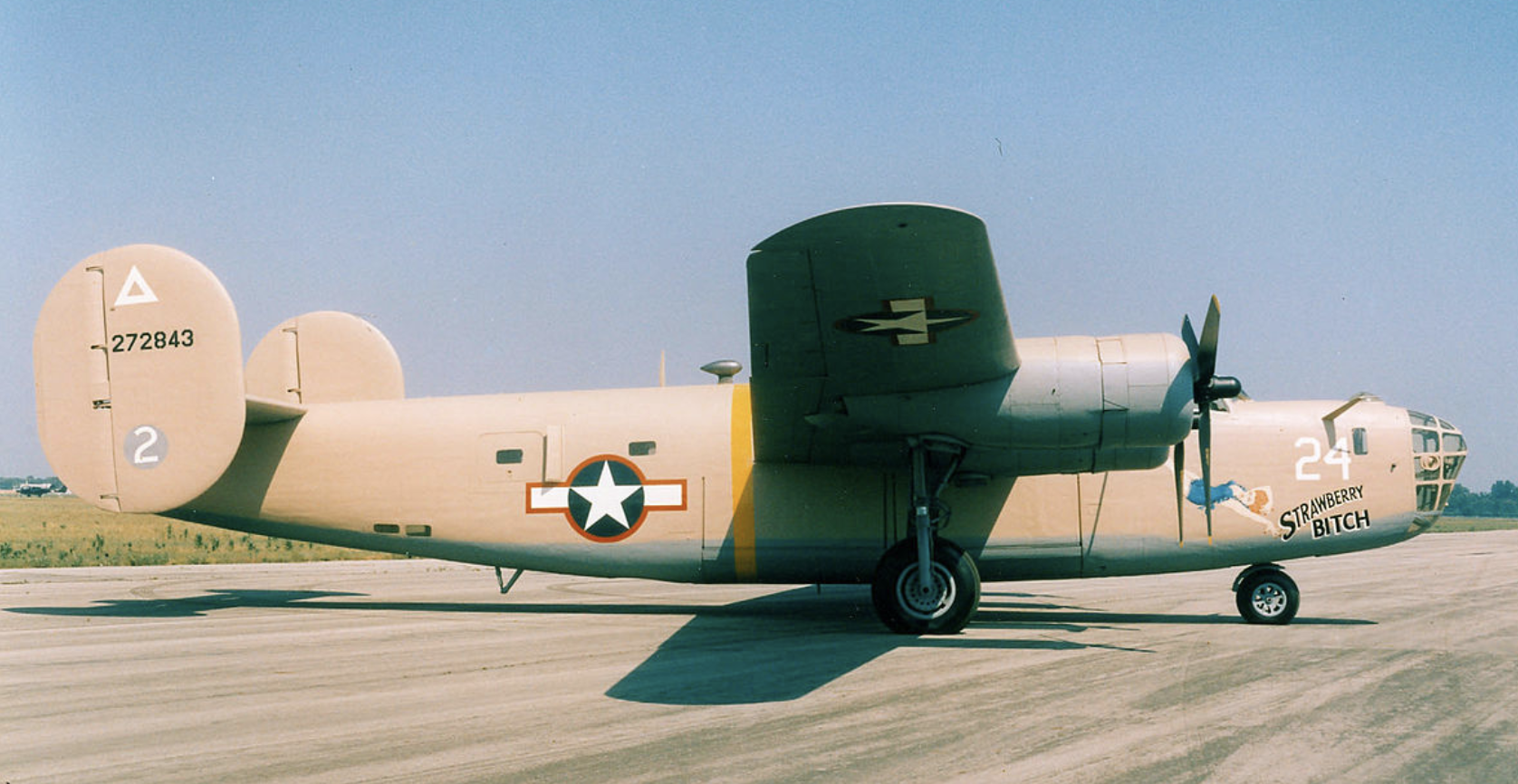
as 2nd Engineer of a B-24 bomber. The crew of a B-24 was made
up of either ten or eleven men. In combat, if there were enough
men, the First Engineer was relieved of firing the top turret
so he could be free to assist the pilot, copilot, or radio
operator. The eleventh man fired the top turret. Up front were
the pilot, copilot, navigator, bombardier (the four officers),
the first engineer who took to top turret, radio operator,
and nose turret gunner. In the back were two waist gunners,
the ball turret gunner, and the tail gunner.
Bill Denton and I were the first men assigned to be part of
our crew. In a short time eight more men were also assigned
to our crew and we started flight training. Our first pilot
had an attack of appendicitis while we were on a training flight.
The copilot, Lieutenant George Jensen, landed the plane with
the 1st Engineer, Staff Sergeant Milton Hewitt, as copilot.
This was the first time either of them had landed a B-24 at
these positions. We landed a lot faster than usual, but otherwise
it was very good landing.
Several weeks later our second pilot got very sick while we
were in the air. This time our copilot was not with us. A major
was flying copilot to get in some flying hours. He took over
as pilot and the 1st Engineer was copilot again. The major
had not landed a B-24 but two or three times, but he did all
right.
We were assigned our third pilot, Lieutenant Eugene Thurman.
He was a very good pilot and leader for our crew. Things went
great until one day the tail gunner found a small piece of
metal and brought it into the barracks. He asked some of the
boys if they knew what it was. They were playing cards and
didn't pay much attention to him. He sat down on the next bunk
and was poking at it. It exploded and blew the ends off several
of his fingers. The piece of metal was a detonator cap for
setting off explosives.
The rest of our training went well, other than flying at 10,000
feet without oxygen during a formation training flight. During
training we didn't have any particular aircraft that we flew
regularly. The altimeter on the plane we had this day was not
working right, so we didn't realize that we were flying high
enough to need oxygen. We didn't report it for fear of being
grounded for some time. The next few days we had a lot of aching
joints, but no serious effects.
After we finished our training our crew was sent to Topeka
, Kansas , to get a new B-24 bomber to fly overseas. We were
there a week or ten days when our plane arrived. We had all
our belongings loaded on the plane but our take off time was
delayed twenty hours. The crew had to stand guard at the plane.
Our pilot, Lieutenant Thurman, had us draw for two-hour shifts.
He and the other three officers, the copilot, navigator, and
bombardier, took their turns. The pilot said we were a ten-man
crew and if the crew only had a dollar it was ten cents each.
That is the way our crew always worked.
We flew from Topeka, Kansas, to Puerto Rico and stayed the
night there. From there we went to British Guiana, South America
. The next day we left for Belem , Brazil . During this flight
the pilot said his compass showed we were going north, not
south. The navigator, Lieutenant Walter McKay, used his astrocompass
and told the pilot the right course. We came in right over
the runway in Belem . We were there a week before getting the
plane's compass repaired.
Our next stop was Dakar, Senegal, Africa . This was a long
flight with little room for error or we would run out of fuel.
We didn't have much left when we got there. The next day we
flew to Casablanca, Morocco. We stayed there a few days. Our
next stop was Algiers. We were given the wrong code, so they
weren't going to let us land alone. They were going to send
fighter planes up to escort us down. The Germans were jamming
the radio which made it even harder for our radio operator,
Sergeant Joe Rosendale, to communicate with the tower. Finally
he was able to get the right code, so they let us land.
The next day we landed in Sicily . Most of the crew was playing
cards but the bombardier, Lieutenant Sinico, and I wanted to
do something else. There was no officers' club there but there
was a place for enlisted men. I told Lieutenant Sinico that
if he would take off his Lieutenant's bars and his hat, he
could get in with me. He put them in his pocket and we spent
a couple of hours together with the enlisted men. When all
the sports equipment that was reserved for the enlisted men
was checked out, our officers would check out theirs for us
to use.
Our next stop was the 513th Bomb Squadron with the 376th Bomb
Group at an air base near Brindisi, Italy . Our crew stayed
at the 376th, but they gave our plane to another group. So
we flew whatever was available. Lieutenant Thurman, our pilot,
flew as copilot with another crew his first mission on December
6, 1943. We were all supposed to fly our first mission with
another crew. But they were short on crews, so on December
7, 1943, our crew flew our first mission together over Athens
, Greece . That was the first time I heard anti-aircraft shells
explode. We were to turn left after dropping our bombs, and
I was to hold a camera out the window to take pictures of the
target. They didn't turn sharp enough, so I couldn't find the
target. I kept leaning out until the wind blew my steel helmet
off. The other waist gunner, Keith Denton, took hold of my
feet. He was afraid I would fall out. That was the only steel
helmet I ever had.
Our third mission was a target in Germany . The plane we were
flying had been on over 50 missions. The engines were not running
right, but our pilot did not want to turn back. We flew into
a snow storm over the Alps in formation, but came out of the
storm with no other planes around. We did turn back because
we could not keep up with the formation. We got back and was
ready to land. But we were about four miles from the air field.
I was in the back of the plane and had checked to see that
the landing gear was down and locked. I called the pilot on
the intercom and verified that the gear was down and locked.
The three other men in the back of the plane were also preparing
to land. We heard a noise in the bomb bay like a cable snapping.
I checked on it but saw nothing wrong. We still had the twelve
500 pound bombs on board. I sat down on a box of ammunition
to take off the electric flight boots and put my shoes on.
Suddenly we hit the ground. As we did an ammunition belt fell
out of a box that was mounted high on the outside wall of the
plane and hit me on the head. The plane hit some rocks and
stopped suddenly. The next thing I knew I landed in the laps
of the other three who were sitting with their backs against
the bulkheads--their usual position during landings. My first
thought was that the landing gear was not locked and had given
way. But when the pilot and copilot seen that we were going
to land in a field they pulled the gear up to make a belly
landing on the cultivated field. I thought that we were landing
on the runway. We were about four miles short of making it
back to the air base.
My head wound bled a lot. By the time several hours later
that the medics got to me they thought I was hurt pretty bad.
I hadn't shaved for a couple of days. I looked pretty rough
with blood running down the sides of my head into my beard.
They gave me my first purple heart for that injury. By the
time I actually got it my head was all healed up.
When the plane stopped moving we tried to open the waist windows
to get out, but they were jammed and would not open. Through
the small glass in the center of the window we could see one
engine smoking. The floor of the plane was about twelve to
eighteen inches off the ground at the belly gun mount. There
was some glass in that section. The tail gunner, Sergeant Nustad,
picked up a fifty caliber machine gun and broke out a hole
large enough for us to crawl through. This plane was built
before they started putting a ball turret in them. So there
was an opening in the bottom where the ball turret was installed
on later planes that was covered with plexi-glass and had bars
across as machine gun mounts. The machine gun was the only
thing we had heavy enough to break the glass and knock the
gun mount out so we could get out.
We used a fire extinguisher and threw dirt on the engine that
was smoking to put out the fire. The pilot and copilot made
a very good belly landing, but we slid into a large pile of
rocks which brought us to a sudden stop. Those in the front
of the plane got out through a broken window in the cockpit.
As the navigator, Lieutenant McKay, was going out he heard
Sergeant Philip Dickey say his feet were caught, and he couldn't
get out. The bombs had come forward and bent the bulkhead against
his feet. A gas line was broken, and high-test gasoline was
dripping on Dickey's lower legs and feet. Lieutenant McKay
went back in the plane and stayed with Philip, and gave him
some morphine for pain. A young boy rode a horse to where we
were but left before we could get the horse to go for help.
A short time later the base sent a plane to look for us. We
fired several flares so they could see us. We also laid down
in the field so they would know someone was injured. They had
trouble finding an opening in the rock wall large enough to
get the medical and rescue equipment to us. Before they arrived
I crawled around the bombs to see if I could get to Philip's
feet, but I couldn't get to them.
One doctor thought they would have to cut his feet off to
get him out. They had to be especially careful because of the
leaking gasoline. But they started tearing the airplane apart.
While they were working we heard a hissing sound that we thought
was a bomb about to go off. We all started to run. The pilot
had an injured leg but he still ran over me. Turned out it
was a leaking oxigen tank. Around 10:00 PM they made the rest
of us return to the base. They got him out about two hours
later, about eight hours after we crashed. They saved Philip's
feet, but he had a lot of trouble and pain the rest of his
life. Years later, while visiting Philip and his wife, Sally,
he told us that back home the morning after the crash their
3-year-old daughter woke up and told her mother, "Daddy went
boom."
A short time after that crash the nine of us--all of our crew
except Dickey, who was in the hospital--was to go to the Isle
of Capri for a week of rest leave. They put about twenty men
on a B-24 to fly us to Naples , Italy . The plane only got
about 500 feet off the ground and wouldn't go any higher, so
we landed and got on another plane. We all enjoyed the week
of leave. But even after the leave our tail gunner, Art Nustad,
was still afraid to fly. He quit flying and was assigned other
duties.
After returning from rest leave we flew ten more missions.
I think they were mostly over Yugoslavia . I had not flown
over Germany until February 22, 1944 , when we went to Regensburg
, Germany . We returned without much trouble. The heater in
the cockpit quit working and our pilot, Lieutenant Thurman's
feet were frostbitten. So our crew was not supposed to fly
the next day.
At 4:00 the next morning they woke me and said I was to fly
with another crew. One of their crew was sick (drank too much
the night before). The pilot of that crew was Captain Henry
B. Gibbons from Ft. Worth , Texas , and the copilot was Second
Lieutenant Michael J. Solow from Grand Rapids , Michigan .
Keith Denton, our other (right) waist gunner, flew with another
crew that day, too.
We were going to Styer, Austria , to bomb a ball bearing factory.
Before we got there we encountered a lot of German fighter
planes, Messerschmidt 109s. All the fighters I saw were Goring
Yellow Noses. I was hit in the left ankle, which was broken,
and had several shrapnel wounds. Whenever we encountered enemy
fire we had flack vests we put on. They snapped at each shoulder.
The snaps were so high on the shoulder that we couldn't snap
them ourselves. The other waist gunner couldn't get one of
mine snapped. So my flack vest must have fallen off in the
fracas. I don't remember ever taking it off. I wouldn't have
gotten as many shrapnel wounds in my chest and back if it had
been in place.
Two of the other gunners were also hit. It was customary for
the pilot to give the order to bail out, but the intercom was
out to the front of the plane. The pilot and copilot may not
have been able to give us the order to bail out even if the
intercom had been working. After we got home we found out that
the pilot and copilot were the only ones killed in our crew
that day. It seems they died from enemy fire while the plane
was still in the air.
When we saw the plane was on fire we made the decision on
our own that it was time to bail out. The place to bail out
of a B-24 was a hole in the floor, not an opening in the wall
like we often picture. We were trained to sit at the hole with
our feet hanging, then jump out feet first. The first guy was
sitting at the hole hesitating to jump. But the second guy
was ready and anxious to get out of the burning plane. So he
shoved the first guy out.
I had trouble getting my parachute on, so I was the last one
of the four men at the back of the plane to get out. The first
aid kit that was on the parachute harness had slipped down
and was in the way to snap the parachute on my chest. I finally
got it. I didn't take the time to unhook my oxygen mask and
intercom. My injured left ankle hurt enough that I was hopping
around on one leg. I didn't want to try to maneuver around
to sit down at the hole to bail out, so I just dove through
the hole head first.
We attached our parachute to a harness on our chest. So we
were trained to lean back when we pulled the rip cord. Otherwise
the shroud lines could cut your face all up as they were yanked
out by the parachute. Apparently I did that okay. I didn't
have any trouble with the shroud lines.
A lot of planes were shot down and a lot a parachutes were
in the air. A German fighter flew by me and the pilot waved
at me. I waved back. It was no time not to be sociable. Glad
he didn't shoot.
We were trained to bend our legs when we landed. I was especially
careful to bend my left leg. I sure didn't want to land on
it. I made a pretty good landing. I landed several yards from
a farmhouse. Four older men picked me up and took me to the
farm house. Later a German soldier came to the house and they
gave me first aid. The navigator of the crew I was with was
in the same farm house. They put us in a bobsled pulled by
two horses and took us to an ambulance waiting on a road. There
was several inches of snow on the ground.
That is the last I remember until I woke up the next morning
in a hospital room in Wels, Austria, with a cast on my leg
and several bandages. I got gangrene in my leg and a week later
an Austrian doctor, Dr. Mussman (pronounced MOOSE muhn), amputated
my leg below the knee. In the bed next to me was Morris Ruttenburg,
the tail gunner of the crew I was flying with. He had been
shot in the right ankle. Two other Americans were in the room--Joe
Fritsche from Sacramento , California , and Lieutenant Kendall
Mork from North Dakota . We spent the next three months in
those beds in that room, and the following eight months in
a prisoner of war hospital.
Read more about
Dean Holman's experience as a prisoner-of-war and his later
recovery.
|