A SHORT HISTORY
of the 376th BOMBARDMENT GROUP
May 20, 1942 to February 22,1945
By Captain Jack Preble
For the benefit, the information, and the morale of those who follow in
our footsteps, this condensed history of the 376th Bombardment Group (H)
is intended. It is hoped that it may, in part, instill within those persons
that common spirit of enthusiasm, devotion, and jealous regard for the honor
of the group we now possess. The compilation of this booklet has not been
officially ordered, or approved. It is not intended as eyewash, advertising
or propaganda. On the contrary, it has been attempted solely for the express
purpose of upholding and maintaining the high 'esprit de corps' which this
group now enjoys. We have our traditions, our heroes, our honored dead. It
is, therefore, to those honored dead that we respectfully dedicate this little
history of the gallant 376th........
Captain Jack Preble
Public Relations Officer
The Heavy Bombardment Group, now known as the 376th comprising
the 512, 513, 514, and 515th squadrons, were originally designated as a special
task force under the command of Colonel Harry Halverson. The organization
was composed of 231 officers and men with a complement of 23 B-24 Liberator
bombers. They were assembled at Fort Meyers, Florida, to take off on a remarkable
flight---the ultimate destination of which was unknown. Early dawn on the
morning of May 20, 1942, saw this hand-picked task force wheel their heavily
loaded aircraft into the rising sun. Sixty-five flying hours later the entire
fleet of these "Flying Stone Crushers", (as they have been so described by
many who have seen them at work), descended June 4th upon the airdrome at
Fayid, Egypt. Without the loss of a single hour of flying time, or man,
all 23 bombers completed the hazardous journey across the waters of the Atlantic,
the fever-ridden swamps and jungles of the Gold Coast, then on into the dry,
hot highlands of the Sudan. Thence, they winged on to the land of the ancient
Pharoahs. Over 6000 miles of difficult, treacherous, and uncharted flying
was accomplished by this organization who called themselves "The Halpros",
in recognition of the outstanding personality of their leader, Colonel Harry
Halverson.
Only a few days elapsed between the arrival of this force and the call
for their first mission, that of bombing and pulverizing the vital Axis-held
oil refineries at Ploesti and Constanza in Roumania. This was a far different
target than many of the unit had anticipated, for it was generally known
that the "Halpros" were destined to fly on to China and from a securely hidden
air base, conduct harassing and annoying raids on the forces of the Japanese
Mikado.
Their first combat mission was a 13 bomber attack on the Ploesti refineries,
on June 12, 1942. Little did they realize that more than two years were
to elapse before Ploesti was finally eliminated as a high priority target.
Like later missions to Ploesti, this initial one was costly. Five bombers
failed to return and were believed to be lost or interned in neutral countries.
The dramatic escapes, the exchanges, the diplomacy exercised on the behalf
of the fever-ridden survivors of this, the first of a long series of missions
against big "P", will some day form a volume of brave deeds in itself.
Thus, their first mission accomplished, the "Halpros" were eager to get
on with the business in Asia. But, disaster faced the heroic British Eighth
Army as Field Marshall Rommel and his devastating Afrika Korps, flushed with
success, threatened the last stronghold of the Allies in Eastern Africa.
Here, close at hand, was urgent need for the pregnant destruction contained
within the belly of the B-24. The extreme pleasure of pulverizing the abode
of the Sacred Son of a Heaven could come later on. That pleasure was mentally
filed under "unfinished business."
So, "business before pleasure", was the thunderous roar omitted by the
spitting engines as they warmed up for the take-off on the morning of June
15, 1942.
It was only their second combat mission but it was, perhaps, the most
sensational of any bombing attack ever performed to date. The entire striking
power of this small handful of bombers directed towards the powerful Italian
Fleet who were causing trouble in the Mediterranean Sea just east of the
Straits of Gibralter. Seven (imagine that!) Liberators taking off to do
battle with the entire Italian Fleet! How pitiful! How inspiring! How
audacious! Yet, so business-like was their performance that day that the
proud Italian Navy licked their terrible wounds as they streaked for home
and the safety of Taranto Bay. They were never to emerge again as a fleet
until their surrender over a year later. So many hits were scored that day
that the 376th bombardiers coined the famous expression: "'Twas just like
shooting fish in a rain barrel." All our aircraft returned.
Then began the many and tiresome raids (they were called 'raids' in those
days) carried on against harbor installations and enemy shipping in Tobruk
and Benghazi. These raids became so much of the daily life of this pitifully
small U.S. Air Force that a bombing mission to Benghazi was called the 'mail
run'. That to Tobruk was called the 'milk run'. But both the 'mail' and
the 'milk' were delivered on time, and when most needed. The fact that both
'milk' and the 'mail' were carelessly camouflaged as 500 and 1000 lb bombs
does not alter the general picture. Benghazi first received its quota of
'mail' on June 21, 1942. On the 23rd, Tobruk got its 'milk'. Neither liked
it, but, like spinach, it was good for what ailed the Axis. Then on and
on, unceasingly from June 21 to Halloween Night on the 30th of October.
Tobruk, Benghazi, enemy convoys and tankers in the Mediterranean Sea, airdromes
and landing grounds in Crete and Greece, were all equally pounded, harassed,
and blasted without fear or favor.
However, during this time, the enemy under the leadership of Marshal "Desert
Fox" Rommel was not unduly lax in their military prestige and endeavors.
The advance of the "Desert Fox" towards the rich cities of Alexandria and
Cairo made it seem wise for the U.S.A.A.F. to get the hell out of Egypt and
head for Palestine. Unbeaten, their shield of battle untarnished, they gracefully
withdrew (not retreat, mind you) to an excellent air base at Lydia, Palestine.
Here, in Palestine, was, for the first time in history, raised The Stars
and Stripes. And raised, neophytes all, by the puling, squawking, lusty
infant which was, later on after a diet of sand, sweat, blood and guts, to
be known as the 376th Bombardment Group.
Operations were carried on from this new base. But, after the mission
of July 1st, 1942, the "Halverson Detachment" was reformed into a new unit,
The First Provisional Bomb Group. And, (this may surprise some of you) their
numbers were augmented by the arrival of several B-17's (Flying Forts) with
their eager-beaver crews. These new arrivals, the 9th Squadron, hot off
the plains of India, received a hotter welcome at Lydia Airport. Things
went on and on from the new Palestinean base.
The 30th day of October witnessed the last mission performed by the 1st
Provisional Bomb Group when a formation of 9 B-24's and 6 B-17's started
out on their 62nd and 63rd mission to bomb the airports of Maleme and Tymbaki
on the island of Crete. Although theresults of this attack were unobserved
due to poor visibility, all the planes returned to their home air base after
fighting off ambitious Axis fliers equipped with the best (at that time)
fighter planes.
Came the morning of November 1st, 1942. Out of the loins of the pregnant
1st Provisional Bomb Group came the 376th Bombardment Group, sired by the
now-famous Halpros. It was a lusty, husky, trouble-making, and highly destructive
infant.
No time was lost in celebrating the birth of the 376th. Though young in
name they were already veterans of almost six months desert fighting. That
same morning of Nov.1,1942, saw them winging their way to make another successful
attack on the Malome, Crete, airdrome with 8 b-24's.
Conditions becoming more and more favorable in the progress of the Libyan
campaign, the 376th was moved to Abu Sueir, Egypt, on November 8, 1942.
The ceaseless pounding at harbor installations, fortifications, enemy shipping
and convoys, as well as Axis airdromes at Benghazi and Tobruk continued on
an ever increasing scale.
After the fall of Tobruk on Nov. 15, 1942, and Benghazi shortly after,
the 376th began again their old systematic and methodical bombing of enemy
targets. This time it was conducted in newer fields and waters. The enemy
had been chased westward to Tripoli, Soussa, Sfax, and Bizerta. Here they
held their last stand in North Africa, punch-drunk, but still as vicious
and dangerous as a wounded panther. These strongly held installations, harbors,
pill-boxes and airdromes were bombed consistently until the capture of Tripoli.
One of the most successful missions carried out during this period was the
"sharpshooting" of the bombardiers when they attacked the harbor of Sfax
on December 16, 1942. This was a feat, now at that time, in precision bombing.
Sixty-nine bombs out of 72 carried were dropped exactly in the bull's eye.
The next base of the 376th was into the Western Desert of Libya where
they were based at Gambut Main Landing Ground #139 on February 6, 1943.
Here the lusty, healthy, and rapidly growing 376th continued to show its
ill manners by causing wholesale destruction and devastation when visiting
over the mainland of Italy and Sicily.
During the month of February 1943, punishing and destructive missions
were carried out against shipping and harbor installations at the ports of
Naples, Palermo, Crotrons and Messina. Many hundreds of tons of shipping
and vital military stores were destroyed by these raids upon the enemy's
dwindling supplies and resources.
On the 27th of February, 1943, the group again moved, this time farther
west into the Libyan Desert to a little town of Solluch. This native town
was once an important Italian military outpost, now it had reverted back
to its rightful owners. They were of the Senussi tribe and soon came back
to town from their hide-outs in the hills and deserts. Solluch was about
30 miles south of Benghazi, the largest city and only port in Libya. Despite
the adverse winter weather conditions and the big cloudburst at Solluch,
operations were continued against the high priority target of that time-the
Messina Ferry Terminal on the north-west tip of Sicily. Due to its strategic
value in being the funnel through which troops, arms and supplies were shipped
from the mainland of Italy to Sicily, and thence to North Africa, every effort
was made to destroy it.
In the middle of April 1943, the 376th again moved their base to within
a few miles south of Benghazi, to the field called Bonina No.2. From this
new base the sensational and successful bombing attack on the airdrome at
Bari, Italy, was carried out on April 26. This mission was led by Colonel
Keith K. Compton who had been assigned as the new group commanding officer
on February 20, 1943. Previously the group had been commanded by Col. George
F. McGuire, who, since July 30, 1942, had succeeded in welding his little
unit into a hard-hitting, hard-fighting, combination Task Force, Desert Air
Force, Tactical and Strategic Bombing Force, and almost every other designation
that could be imagined. No job was too tough, no job was impossible for
the 376th. Just let one of the "brass hats" mention a nasty little job that
had to be done and the 376th boys would actually be "peed-off" if they were
not allowed to take a crack at it.
Under Colonel Compton, some of the most audacious and adventuresome missions
were conducted. Col. "K.K." thought so much of the versality, and the destructive
potentialities contained in the B-24 that it could, in the hands of expert
pilots, be used for almost anything. No one before had thought of using
B-24's for low-level bombing. If ever this thought had crept into their
minds it had been instantly dismissed as suicidal. Every one except Col.
Compton, who thought it could be done, and done well right, IF the right
men were available. And he had the right men for the job. Any job!
These men of the 376th were willing to try anything once, so, when it
was suggested that in order to destroy the Messina Ferry Terminal, "skip-bombing"
should be tried, they were all for it. The Ferry Terminal was the receiving
end of ferries carrying freight and passenger cars across the Straits of
Messina. Upon arriving at the Terminal they passed under the Terminal into
a tunnel protected by many feet of re-inforced concrete. Impossible to blast
from above and thus reach the mechanism that controlled the hauling of the
freight trains from the ferries on to the land tracks, it was decided to
fly in low and try and skip the bombs into the open mouth of the tunnel.
Due to the intense and highly accurate anti-aircraft fire protecting the
Straits of Messina, the original "ack-ack alley", it was decided best to
make the attacks at sundown, coming in low towards the Ferry Terminal with
the sinking sun low on the horizon to blind the ground gunners.
It would take many pages to describe these hair-raising, low-level missions
against Messina and we have only room for one or two incidents. Jerry DuFour
was piloting one of the big Liberators for the entrance of the Ferry Terminal
opening on one occasion. He had just skidded his bombs into the tunnel's
mouth when he saw, dead ahead of him, a flight enemy Junkers cruising his
way. Both were surprised as it was an accidental meeting. There was nothing
else for DuFour to do but plow straight ahead with all his machine guns firing
right and left. Right into the middle of the enemy planes he flew, shooting
down one and scattering the rest. The enemy was so caught by surprise at
seeing this terrible, spitting monster coming at them where none was supposed
to be that not one shot was fired at Jerry's Lib!
Then there was the time when Major Norman C. Appold got bored with just
merely skip-bombing the Messina Terminal and made a one-plane, low-level
strafing attack on a chemical plant, airdrome and railway yards at Crotone,
Italy.
The installations at Messina were entirely wrecked by these daring attacks.
Came next the systematic pounding of Reggio di Calabria (across the Straits
on the toe of Italy), and softening-up and pulverizing of all the supply
dumps, harbor installations and airdromes in preparation of the invasion
of Sicily. Other notable missions followed, the bombing of the Littorio
Railway Yards in Rome is one in particular. The day before the Rome mission
British planes circled over the Eternal City and dropped leaflets telling
the inhabitants to get up on their roof-tops next day at noon and see a good
example of the American's precision bombing. The leaflets told the natives
to keep away from the Littorio rail yards as that was to be the target for
the coming day. The next day, July 19, 1943, at high noon the drone of B-24's
could be heard over Rome. Swinging surely towards their assigned target,
with all the confidence in the world in their ability to squarely hit their
objective, the bombs were sent hurling downwards with such grace and precision
that the yards were rendered entirely useless for further movement of enemy
supplies towards the Americans, Canadians, and British forces.
Then came the most daring and outstanding mission of all time, the historic
low-level bombing attack against the oil refineries at Ploesti, Roumania,
on August 1, 1943. For 14 months, or since June 12, 1942, Ploesti had been
untouched by warfare. Not only was this attack to be famous on account of
its daring and audacious low-level approach, it was also to signal the re-opening
gun of The Battle of Ploesti which was only to end a year later with the
loss of 276 bombers and 2,200 airmen missing. Historians in years to come
will elaborate more fully on this historic attack, and the attacks that followed.
Just as the 376th had been cited by the President of The United States for
its efforts in North Africa, so was it again to be cited for the devastating
bombing attack of Sunday, August 1, 1943.
This low-level attack was planned for a Sunday afternoon when the pleasure-loving
populace of Roumania would relax their guard and be indulging in pastimes
other than war. The flight across Roumania "on the deck" towards Ploesti
had its amusing moments. One crew reported passing over a small river where
many young men and girls were lolling on the sand after an enjoyable swim.
What particularly attracted the attention of the men of the 376th was that
these parties were as entirely naked as a jay-bird. Others were engaged
in an interesting and highly pleasureable biological act. Imagine, if you
can, being caught yourself in this dilemma! Suddenly, out of nowhere, came
the first of the thundering herd of eager bombers directly headed for them,
or so it seemed. Never before in all history had the curtain been run down
on shorter acts as the lovers scattered themselves like covey's of quail
and either rolled into the bushes, or dived into the river, to escape the
terrible pre-historic monsters overhead.
In one field a farmer was spreading manure from a farm wagon drawn by
two horses when the bombers swept over the tree tops behind him. He and
the horses gave one terrified look. Then, the peasant's pitchfork went one
way and he headed, full speed, for the shelter of the woods. The horses,
being unable to decide which way to run together, decided to part company
and go their separate ways, also at full speed, with the wreck of the wagon
bumping and trailing behind.
One Liberator came home with cornstalks wedged in the engine cowling,
while parts of some black and white bird were found in another. It was either
a chicken or magpie with the odds being in favor of chicken. Other Liberators
came home with hay and small tree branches and leaves decorating the cowling.
Many of the Liberators didn't come home that night.
After Ploesti came the bombing attacks on ball-bearing and aircraft factories
in Germany and Austria. The mission to Weiner-Neustadt, Austria, on Aug.
13, 1943, was, perhaps, the longest mission carried out from the base at
Benghazi.
The war progressing favorably to a point where it was believed the 376th
should again move forward, about the middle of September this movement was
started. The new base was near Enfidaville, in southern Tunisia, at the
base of a range of purple and gold mountains. One of the things most distinctly
remembered about this new base was the hunting of chukkar partridges, the
beautiful sunsets reflected on the mountains, and another of those terrible,
desert cloudbursts.
Operations carried on from Enfidaville took the group again to Weiner-Noustadt,
and other targets in that vicinity. As Colonel Compton was still commanding
the group, several more requests were made of him to again use his famous
low-level, skip-bombing, hit-and-run tactics against several railroad bridges
and viaducts along the east coast of Italy. One in particular was the mission
of October 19, 1943. The following is a newspaper account of that daring
affair:
"Early today, echoing the thunderous blast of exploding
2000-lb bombs aimed at four enemy-held bridges, came Colonel K.K. Compton's
terse radio message back to his home air base: "All bridges busted beautifully!"
"Many times in the past have Colonial Compton's Liberandos been called
upon to perform skillful, hazardous and hair-raising jobs. This morning's
raid, carried out 'on the deck', or just skimming the crest of the waves,
was no exception.
"Briefed to destroy these four bridges, vital links in the only railroad
on the east coast of Italy, and the destruction of which would cut off reinforcements
to the hard-pressed enemy, the Liberandos struck at dawn.
"Sweeping in from the sea in a surprise attack they skidded their huge
bombs into the piers and abutments of four separate bridges, some spanning
miniature 'Grand Canyons', and swept out to sea again to escape the awful
upheaval that followed. From this operation all our planes returned safely."
On the 17th of November, 1943, the 376th took to the air again. This
time it was headed to Italy for a long stay. The combat personnel, as well
as the important ground personnel were all flown to southern Italy where
their new air base was to be set up. It was during this movement by air
that occurred a most laughable and memorable incident. Laughable, yet it
had all the possibilities of a disaster save for Lady Luck.
It was this: Two B-24's took off, one shortly after the other, for the
hop across Sicily to the new base. The navigator of the second B-24 had
no navigational aids other than a map, so he was told by the pilot of the
leading bomber, "Just follow us.' Follow they did, until over Sicily they
experienced dense cloud cover and each became separated. The first B-24
proceeded on course while the second one took this most in-opportune time
to have trouble with the radio compass and almost everything else and became
lost...utterly lost. It was rapidly getting dark. The plane was heavily
loaded with kitchen stoves, pots, pans, kettles, and all the 515th Squadron's
contingent of Mexican-American cooks and helpers. Imagine their consternation
when enemy anti-aircraft guns opened fire on them. They high-tailed it for
some other less hostile area. Their next alarm was when two ME-109's came
out of the dusk with all their guns winking and blazing at the lost Lib.
On board was a crew chief who sprang into action at this new threat to their
welfare and succeeded in driving off the ME-109's in short order. After
flying aimlessly around for sev- hours they eventually got in contact with
a friendly ground radio station and were guided in to the new air base where
their Odyssey of the Clouds was related to bug-eyed skeptics.
The above true story never before appeared in print, and to protect the
reputation of the navigator, his name will not be divulged here. Just call
him "Sam". The details of this story are familiar to many of the old "desert
rats" still in the group. They still relate this story with great gusto.
On January 8, 1944, the 376th welcomed its new commanding officer, Colonel
Theodore Q. Graff. A few years more mature than Colonel Compton, still he
had that exhuberance of youth about him, combined with a quiet dignity, that
endeared him to all. He was the type of man the 376th had been accustomed
to, and wanted. First of all they wanted a leader, a combat pilot willing
to lead them on any of their "rough" assignments. They also wanted a confidant;
a "tough" but "fair" boss; a "brass hat" without too great a show of brass.
They got all these qualities in Colonel Graff. Lucky, indeed, has been
the 376th in getting the "cream of the crop" for its commanding officers.
In January 1944, the 376th reverted to the close ground-air support tactics
developed and conducted a year or more before in the Western Desert. Almost
the entire month of January was spent in an extensive training program in
preparation of the coming Spring offensive when these tactics would be used.
Then began the missions to the Anzio beachhead where German troop concentrations
and gun positions were blasted. Subsequently, one mission was flown against
bloody Cassino-on the day when more than 3,000 Allied aircraft participated
in an attack against this mountain monastery stronghold.
It was during the many missions flown against enemy positions and troop
concentrations that one of the bravest acts of self-sacrifice in the history
of the 376th occurred. On May 23, 1944, a mission was sent out to bomb enemy
troops and supplies at Frascati, Italy. The anti-aircraft fire was both
accurate and intense. Aircraft 85, piloted by Bob Gallagher, received a
direct hit underneath the waist windows which traveled upwards and exploded.
The entire top of the bomber was blown out from the radio antenna to aft
of the waist windows. Two life rafts and several parachutes were blown out
by the explosion and several of his men were wounded. Other serious damage
was rendered to the bomber. Here was a choice no man should have to face.
Should the unwounded men, and the men with parachutes, bail out and save
their own lives while the wounded, and men who had lost their chutes in the
blast, remain and go down with the stricken ship?
Anyone who knew Bob Gallagher and his co-pilot, Hollis Fuller, or any
of the crew, would know there was no doubt in anyone's mind what they would
do. Give up? Sacrifice the wounded men? Every man for himself? No! Not
those boys of the 376th. They were going to try and bring the damaged plane
to the nearest friendly field with every soul aboard or die in the attempt.
And those men died! Every one of them!
Despite the terrible damage inflicted to their bomber, Bob piloted it
out to sea and rid himself of his load of bombs and then headed his crippled
aircraft for Naples. All went well until within sight of the airfield at
Naples, when suddenly, the crippled bomber went out of control and crashed
to the ground. The frayed controls could hold no longer. No survivors was
there to tell of those terrible hours in the air. Radio facilities had been
blasted out of Gallagher's bomber when it was hit. No one knows the heroic
acts that occurred aboard the stricken ship. What went on up there in the
air between these doomed men and their God...God alone knows. Our story
is based on eye-witness reports of other pilots who tried to escort Bob and
his heroic "One for all and all for one" crew safely to a friendly base.
Bob Gallagher, the little, happy-go-lucky, smiling Irishman received a posthumos
award of The Distinguished Service Cross. His crew received posthumous awards
of The Silver Star for gallantry in action.
It was dogged, determined, heroic acts like Gallagher's, and Fuller's,
and later on, Frank Christiansen's (The Terrible Swede), who also won the
D.S.C. for his unfailing courage and undaunted spirit in combat, that helps
make up the traditions, the history, devotion, and the jealous affection
for the honor of the group we have. More D.S.C.'s have been won by men of
the 376th than any other group in the 15th Air Force. And more Silver Stars,
Distinguished Flying Crosses, Legion of Merits, and Bronze Star Medals also,
if the truth were know. Not all the heroic acts that make up the historic
traditions of the 376th were performed by airmen, or in the air. The ground
personnel have their share of Soldier's Medals gained by saving another's
life at the risk of their own.
Throughout the year, oil installations, ball-bearing and aircraft factories,
engine and tank factories, airdromes, harbor installations, railway lines,
yards and bridges, troop concentrations and other strategic targets were
blasted in Germany, Austria, Hungary, France, Czechoslovakia, Italy, Greece,
Roumania, Bulgaria, and Yugoslavia. All these and many more were on the
376th intensive bombing program.
The group gave air support to the Russian Armies both in Roumania, and
southeastern Poland when it led the entire 15th Air Force in the attack on
the Bucharest railyards. The group participated in the invasion of southern
France when coastal batteries, barbed-wire, pill-boxes, mine fields, fortifications
and other strongholds were neutralized before the waves of infantry, engineers
and artillery swarmed ashore.
For the outstanding and highly successful mission on June 16, 1944, when
the entire set-up of tanks, oil refineries, distillation and cracking plants
at Bratislava, Czechoslovakia were utterly destroyed, the 376th won its third
citation as a Distinguished Unit.
Other oil targets were hit repeatedly to prevent any great German recuperation
of these industries. The vitally important Breener Pass railway lines, tunnels
and bridges in north Italy, as well as supply depots, were bombed in the
closing months of the year of 1944. Rail installations and bridges were
attacked in Hungary and Yugoslavia repeatedly in order to check the flow
of vital supplies to the German fronts. Troop movements were attacked also.
On Nov. 8, Colonel Graff led a successful mission to destroy troop concentrations
at Prijepolje, Yugoslavia. Just as a sample of precision bombing dealt out
to other targets, this day the 376th dropped every bomb directly within a
1000 feet circle and scored a 100% record. How this perfect record affected
the enemy troops concentrated in that 1000 foot area is no military secret
for they are long past caring.
On February 1, 1945, another milestone in the long and gallant career
of the 376th was set up when Colonel Graff led the unit on its 400th combat
mission. It was also the Colonel's last sortie against the enemy before
being eligible to return to the United States for reassignment. The group
felt his loss very keenely as he had been responsible for building up his
group to a high state of efficiency.
On 22 February, 1945, Colonel Robert H. Warren assumed command of the
376th Bomb Group. Colonel Warren comes to the 376th, not as a stranger,
but as an old friend, as he commanded the 515th Squadron for several months
early in 1944. He is a graduate of the U.S. Military Academy, and won his
pilot's wings at Maxwell Field in March 1941. Col. Warren, like his predecessors,
is a strict and most fair officer; a 'brass hat' without ostentacious display
of brass.
He has stated he will make no change in the policies of the 376th, but
will ever strive to uphold and maintain the same high standards; standards
and achievements which have given the 376th its glory, its history, its traditions
and its honors.
As this short history goes to press the enemy has been defeated on every
front and now fights with his back to the wall in Germany, parts of Hungary
and Austria, and northern Italy in the Po River valley. The 376th has advanced
a long ways, from Egypt, Libya, Tunisia to Italy. It has aided in the liberation
of those countries as well as Greece, Crete, Bulgaria, Roumania, Albania,
France, Poland, Czechoslovakia, Sicily and more than half of Italy. Three
times it has been cited as a Distinguished Unit, and has been awarded 9 campaign,
or battle stars, and is now expecting the 10th. Veterans of the 376th who
joined the group in Palestine or Egypt and are still with the group are authorized
to wear these nine campaign stars. They are as follows:
EGYPTIAN*LIBYAN: For those who were with the group up to and including
February 12, 1943.
TUNISIAN: November 8, 1942, to May 13, 1943
SICILIAN: May 14, 1943 to August 17, 1943.
PLOESTI: August 1, 1943. Only men associated with the group at this time
may wear the star for 'The Battle of Ploesti'.
NAPLES*FOGGIA: September 9, 1943 to January 21, 1944.
SOUTHERN FRANCE: August 15, 1944 to September 14, 1944.
ROME*ARNO: January 22, 1944 to (date still open).
NORMANDY: June 6, 1944 to July 21, 1944 (Strategic support).
AIR OFFENSIVE OVER EUROPE: July 4, 1942 to June 5, 1944.
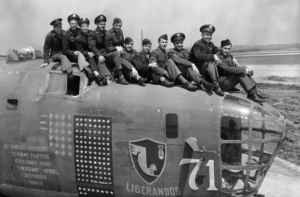
The Liberando shield insignia of the 376th Bomb Group, although still
unofficial, is yet the unanimous choice of all personnel. The winged Sphinx
is symbolic of the Middle East where the group commenced operations. It
is depicted in yellow. The blue background of the shield is for the blue
of the Air Force as well as for the intense blue of the African sky at night.
The terra-cotta red beneath the Sphinx is for the red soil of the Western
Desert around Gambut, Solluch, and Benghazi. LIBERANDOS are members of the
376th Bombardment Group. The bomb is self-explanatory. The circle, pyramid,
diamond, and the square on the bomb represent the four squadrons that make
up the 376th Bomb Group.
During its career, the 376th has been a unit in three different Air Forces.
First the Ninth Air Force, then the 12th Air Force, and at the present time,
the 15th Air Force.
It is not generally known that the 376th has, within the group, as Air
Force all its own. This air force is The Yugoslav Air Force, operated by
Yugoslav nationals trained in the United States. They made their debut in
November 1943 in four B-24 Liberator bombers presented to them by President
Roosevelt at Bolling Field on their completion of a year's training in America.
Teaming up with the 376th, the Yugoslav's returned, on November 16th, to
bomb hangars, administration buildings and parked aircraft at Eleusis Airdrome,
northwest of Athens, Greece. It was from Eleusis that these same Yugoslav
airmen escaped in their own planes when Axis troops over-ran Greece in the
Spring of 1941. After receiving the Liberators from President Roosevelt,
the Yugoslavs ferried them to Cairo, where King Peter officially accepted
them on behalf of the Yugoslav exile government. They have fought honorably,
bravely and have a distinguished war record. Never have they been called
upon to fight against, or attack targets, in their own country. Their losses,
for such a small air force, have been extremely heavy. Today only one Liberator
remains of the four originally presented to them. The others have been lost
in combat against the enemy.
|
|